



31 terms

Cacophony
Cacophony is an unpleasant, ear-jarring sound of speech, caused by a heavy cluster of consonants, an unfortunate coincidence of sounds, monotonous repetition or a disharmonious combination of sound elements. Most often cacophony is a consequence of carelessness or a low culture of language and is considered a stylistic flaw to be removed by editing the text. However, in literature discordance may be used deliberately as an expressive means: harsh, "heavy" sound combinations reproduce the disharmony of the depicted world, convey tension, anxiety, ugliness or the coarseness of a phenomenon. Such purposeful sound-writing is subordinated to the artistic design. Cacophony is opposed to euphony and is studied by phonostylistics in the aspect of the aesthetic evaluation of the sound organisation of speech and its correspondence to the content and mood of a work.
Caesura
The caesura is a fixed rhythmic pause within a verse line that divides it into two relatively independent segments (hemistichs). The caesura is especially important in long measures — hexameter, the alexandrine, the Ukrainian syllabic thirteen-syllable line — where it orders the movement of the line and eases its pronunciation and perception. The position of the caesura is usually constant within a single work (for example, after the sixth syllable of a twelve-syllable line). The caesura not only segments the line rhythmically but often coincides with a syntactic boundary, underscoring the semantic opposition of the two hemistichs. Its shifting or omission is an expressive rhythmic device, noticeable against the background of the fixed scheme.
Carnivalization
Carnivalization is a concept of Mikhail Bakhtin denoting the influence of folk laughter (carnival) culture on literature. Developed in 'Rabelais and His World' (1965), it rests on the analysis of the medieval carnival as a temporary suspension of hierarchies, prohibitions, and privileges — a celebration of the 'world turned inside out.' The carnival worldview is characterized by ambivalence, the 'grotesque body,' the 'material-bodily lower stratum,' crowning-and-uncrowning, the profanation of the sacred, and universal laughter. Literary carnivalization transfers these forms into the text: the mixing of high and low, eccentricity, parody, and renewing laughter. The category is productive for analyzing 'menippea,' Baroque and Renaissance literature, and contemporary prose. In Ukrainian letters, the carnival element is embodied in Ivan Kotliarevsky's 'Aeneid' and the prose of Yuri Andrukhovych.

Catachresis
Catachresis is the stylistic combination of logically or semantically incompatible words used in a figurative sense, resulting in an inwardly contradictory but expressive image: "red ink," "burning ice." Catachresis arises either through the erasure of metaphoricity (when the figurative meaning has become fixed in the language as the only name of an object, as with the legs of a chair) or as a deliberate bold device on the border of linguistic norm that strikes by the unusualness of the combination. In the first case catachresis is imperceptible and common; in the second it becomes a means of emphatic, even shocking imagery. This concept is important for understanding the mechanisms of metaphorical transfer and the limits of word compatibility, and for analysing avant-garde poetics with its orientation toward the violation of habitual connections.
Character
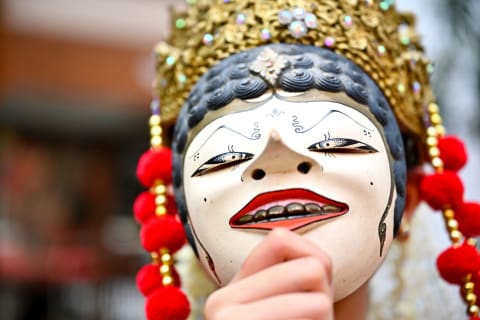
A character is an acting personage of a literary work, the bearer of the plot's events, the subject of the depicted action. The concept of 'character' (persona) is broader than 'characterological type': a character may be not only a human but also an animal, a fantastic being, or a personified phenomenon or object. By importance in the work, one distinguishes main, secondary, and episodic characters; by role in the conflict, protagonist and antagonist; by function, 'flat' (bearers of a single trait) and 'round,' multidimensional ones, in E. M. Forster's terminology ('Aspects of the Novel'). The means of creating a character are portrait, speech characterization, deeds, psychological analysis, self-characterization, and evaluation by other characters. Narratology regards the character both as an 'actant' (per A.-J. Greimas) and as a 'being' with the illusion of psychological fullness. Unforgettable Ukrainian characters are Chipka of Panas Myrny and Zakhar Berkut of Ivan Franko.
Character (as Personality)
Character (as personality) in literary studies is an artistically convincing, internally motivated depiction of a personage's personality in the unity of its individual and typical traits, in development and in connection with circumstances. Unlike the 'character' (persona) as a formal unit and the 'type' as a generalization, this sense of 'character' emphasizes the psychological fullness, integrity, and uniqueness of the depicted personality. The problem of the artistic character was sharply posed by 19th-century realism with its attention to the social and psychological conditioning of the human being ('the human and the milieu'). Classical aesthetics (Georg Hegel) saw in character the concentration of the general in an individual form. Mastery of characterization is a criterion of the artistic worth of prose and drama. In Ukrainian literature, deep, psychologically motivated characters were created by Ivan Nechui-Levytsky, Panas Myrny, Ivan Franko, and Valerian Pidmohylny.
Characterization
Characterization is the system of artistic means and devices by which a writer creates the image of a personage and reveals their nature, psychology, and worldview. The main means of characterization include: the portrait (description of appearance), speech characterization (a personage's individualized speech), deeds and behavior in conflict situations, psychological analysis (inner monologue, the 'dialectics of the soul'), self-characterization, characterization by other personages and by the author-narrator, the 'telling' name, landscape and objects as a means of indirect characterization, and the detail. Characterization may be direct (immediate authorial evaluation) or indirect (character is revealed through action). Mastery of characterization is one of the chief criteria of the artistic worth of an epic or dramatic work. Diverse, psychologically motivated means of characterization were used by Panas Myrny, Ivan Franko, Volodymyr Vynnychenko, and Valerian Pidmohylny.

Chiasmus
Chiasmus is a stylistic figure consisting in the mirror-like, crosswise arrangement of the parallel members of two adjacent segments of speech: if in the first the order of elements is direct (AB), in the second it is reversed (BA). The name derives from the Greek letter "chi" (Χ), whose shape symbolises the crossing. Chiasmus creates a symmetrical, closed composition of the phrase, emphasises the semantic opposition or identity of its parts and lends the utterance an aphoristic, chiselled quality ("We eat to live, not live to eat"). This figure is widely used in proverbs, maxims, oratorical speech and poetry. Chiasmus belongs to the figures of syntactic parallelism and demonstrates how the symmetry of construction can become an independent means of artistic expressiveness.
Chimeric Prose
Chimeric prose (khymerna proza) is a stylistic current in Ukrainian literature from the late 1950s to the 1980s (flourishing in the 1970s and 1980s) that combined the realistic depiction of reality with folkloric-mythological fantasy, parable, grotesque, conventionality, ironic play, and free composition, becoming the Ukrainian counterpart of world Magic Realism. The name is connected with the subtitle of Oleksandr Ilchenko's novel The Cossack Line Has No End, or Mamai and the Strange Young Woman — 'a chimeric novel'. To the current belong the works of Valerii Shevchuk (The House on the Hill, Three Leaves Beyond the Window), Volodymyr Drozd, Vasyl Zemliak's novel A Flock of Swans, and the prose of Yevhen Hutsalo. Chimeric prose drew on the Baroque tradition, folk demonology, and Cossack legends, allowing writers under censorship to speak of national history, memory, and spirituality in the language of myth and parable. It became an important bridge to postmodern prose.
Chronicle
The chronicle (litopys) is a historical-narrative genre of early writing — a year-by-year exposition of historical events in which the documentary recording of events was combined with legends, tales, admonitions, and artistic narration. The chronicle was the leading genre of the literature of Kyivan Rus. Its most outstanding monument is The Tale of Bygone Years, compiled at the beginning of the twelfth century (traditionally associated with the name of the monk Nestor), which recounts the origin and early history of Rus. Later arose the Kyiv and the Galician-Volhynian chronicles, and in the Cossack era the Cossack chronicles of Samovydets, Hryhorii Hrabianka, and Samiilo Velychko, which reflected the liberation struggle. The chronicle tradition influenced the historical consciousness of the nation and imaginative literature; chronicle plots and stylistics were taken up by Taras Shevchenko, Panteleimon Kulish, and Lina Kostenko.




